Illustrative Scenario
E-commerce order exception flow
Illustrative scenario · not a client engagement
Current situation
An online seller takes orders on more than one channel. Most orders pass through untouched, but a minority stall on a missing address, a stock shortfall, a payment problem or a shipment that never scans.
The flow we propose
Order events are received as they happen, exception types are detected against written rules, an internal task is created with the full context, and a customer message is drafted. A retry can never apply the same action twice.
From a real run
An order exception opens automatically, a message is drafted for the customer, and a person approves it before anything goes out.
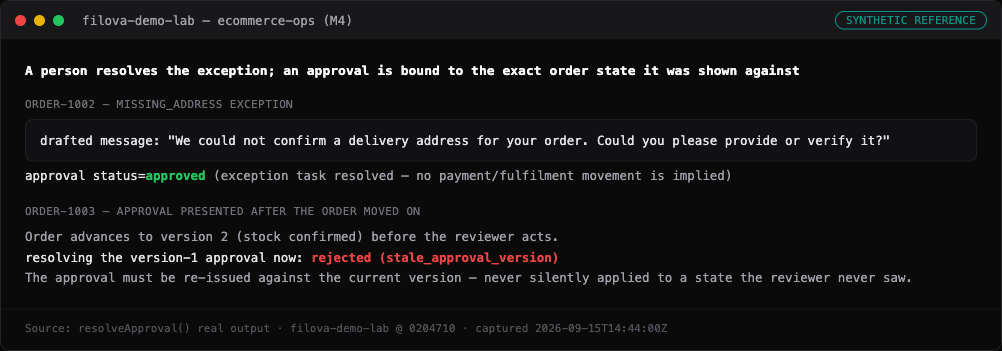
Captured from our synthetic reference build — not a client result.View full size →
How it works today
Someone scans the order lists once or twice a day, spots the stuck ones, opens each channel to check the detail, writes to the customer, and remembers to follow up later.
Human control points
- A refund is never issued by the system. It requires explicit human approval.
- An order cancellation requires human approval before anything is sent to the channel.
- Any price change is approved by a person, never applied automatically.
- Customer messages are drafted for review during the pilot rather than sent directly.
Failure and delay points
- Exceptions are found late because nothing raises them proactively.
- The same message is sent twice when two people pick up the same order.
- Stock counts drift between channels while an exception is open.
- Customers contact support because they were not told anything.
What the pilot measures
- Time from the event to the first human action
- Manual steps per handled exception
- Duplicate action rate on the test set
- Share of exceptions where the customer was informed before contacting support
Technical detail and assumptions
Systems and data
Order and stock events from the sales channels through supported APIs and webhooks, an internal task list, and a notification channel for the team. Only the order fields needed to classify and explain the exception are read.
Baseline assumptions
- Assumed volume: about 1,200 orders a month across channels. Scoping assumption, not a measured figure.
- Assumed exception rate: roughly 4 percent of orders, used only to size the queue.
- Assumed detection delay today: several hours, based on how often the lists are checked rather than on logged data.
Pilot scope
One exception path from event to drafted notification, on one channel, with human approval on every irreversible action. No pricing automation, no channel-wide stock rewriting, no automatic refunds.
Risks, exclusions and fallback
- Channel API limits and provider outages are dependencies. When events cannot be read, the flow alerts the team instead of assuming there is nothing to do.
- The workflow is designed to reduce overselling risk across channels, not to remove it.
- If idempotency cannot be established for an action, that action stays manual.
What moving to production would require
Written exception rules agreed with the operations owner, an approval path with named approvers, durable idempotency keys, a retention decision for order data, and a rollback that stops the flow without leaving exceptions unattended.