Illustrative Scenario
Invoice matching against purchase orders
Illustrative scenario · not a client engagement
Current situation
A finance-ops team receives supplier invoices by upload or email and checks each one against a purchase order and delivery record before it is entered into accounting.
The flow we propose
An uploaded invoice has its fields extracted, the amounts and line totals are checked deterministically against the purchase order and delivery record, and any mismatch is placed in a side-by-side review for a person before anything is written to accounting.
From a real run
Extracted invoice details are checked against the purchase order automatically, and anything that doesn't match is held for a person to review.
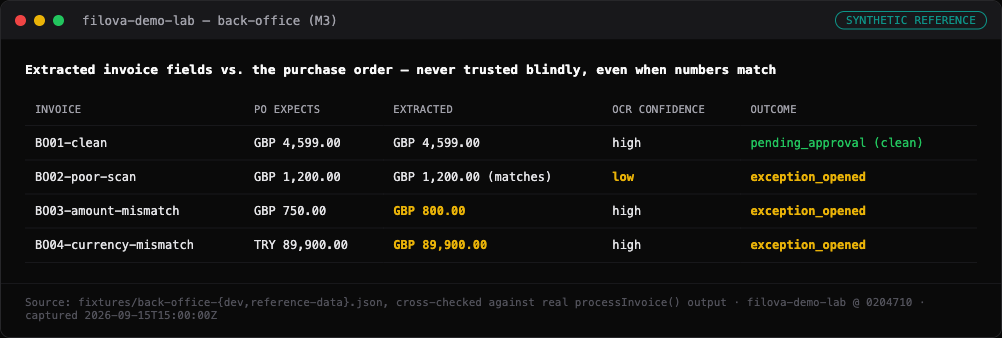
Captured from our synthetic reference build — not a client result.View full size →
How it works today
Someone opens the invoice, reads the amounts and line items by eye, checks them against the purchase order, and retypes the confirmed figures into the accounting system.
Human control points
- Every write to the accounting sandbox requires explicit human approval of the exact extracted values.
- If a field is corrected after approval, the earlier approval no longer applies and the record needs a fresh one.
- A duplicate upload of the same document is flagged for a person, never silently reprocessed.
Failure and delay points
- A mismatch between the invoice and the purchase order is sometimes only found after payment.
- Manual re-keying introduces amount or currency errors that are hard to trace back.
- The same invoice is occasionally uploaded and processed twice.
- There is no consistent record of who approved which figure.
What the pilot measures
- Field-level extraction accuracy, amount and currency errors reported separately
- Review minutes per invoice against the agreed baseline
- Duplicate-document detection rate on the test set
- Rework rate after a correction is made
Technical detail and assumptions
Systems and data
A document intake surface, the purchase order and delivery records, and an accounting sandbox. Only the fields needed for matching and approval are read from each document.
Baseline assumptions
- Assumed volume: a modest number of invoices per month, taken as a scoping assumption rather than a measured figure.
- Assumed manual review time per invoice today, based on a walkthrough of the current process rather than a time study.
- Assumed mismatch rate, used only to size the review queue during a pilot.
Pilot scope
One supplier or invoice type, extraction plus deterministic matching only, and a sandbox accounting write. No automatic payment release, no change to live accounting records.
Risks, exclusions and fallback
- A poorly scanned document is routed to manual review rather than guessed at.
- This scenario is about matching and review discipline. It makes no claim about payment-approval authority.
- If the accounting sandbox is unavailable, the invoice waits in review rather than being marked processed.
What moving to production would require
A named approver, a retention and deletion policy for uploaded documents, accounting credentials with least-privilege scope, and a rollback that disables intake without losing invoices already in review.