Illustrative Scenario
A shared operator view across systems
Illustrative scenario · not a client engagement
Current situation
An owner or operations manager has no single reliable view of what is running, what is stuck, and what needs attention across the systems already in place.
The flow we propose
Run and event records already produced by other modules are mapped into one shared schema, freshness is computed per source, and an authorised operator can drill into a record and request a controlled re-run when needed.
From a real run
One panel brings together the status of several internal processes, so nothing gets missed because it lives in a different tool.
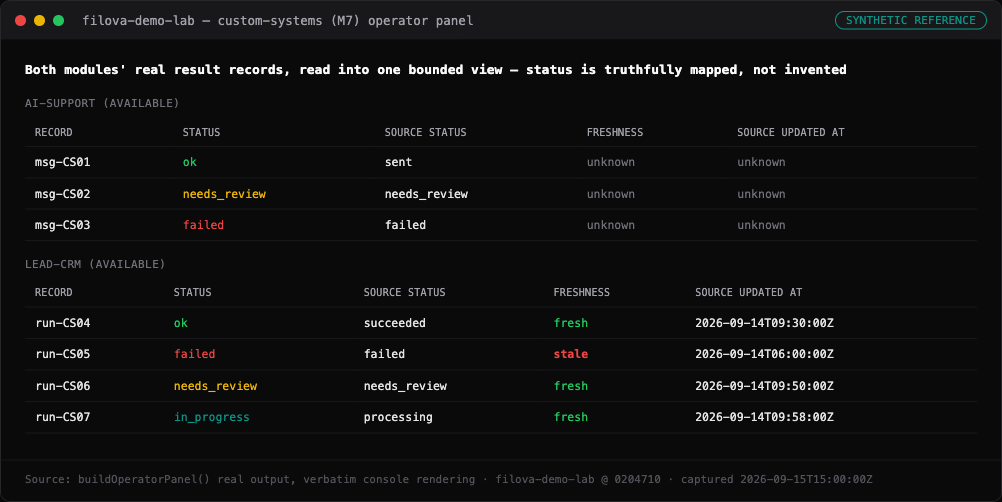
Captured from our synthetic reference build — not a client result.View full size →
How it works today
Each system is checked separately, there is no shared view of state, and it is easy to lose track of whether a number on screen is current or already out of date.
Human control points
- Only an authorised operator may trigger a re-run.
- An unauthorised retry attempt is rejected outright, not queued or logged as a soft warning.
Failure and delay points
- Data that is actually stale is sometimes displayed as if it were current.
- A failed run is only discovered well after the fact.
- There is no consistent way to tell what is currently running from what has already finished.
What the pilot measures
- Data freshness per source
- Reconciliation delta between the panel and the source system
- Detection and recovery time for a failed run
- Unauthorised-retry rejection rate
Technical detail and assumptions
Systems and data
Read-only access to the run and event stores of whichever other modules already exist. This module explicitly depends on those modules being in place first.
Baseline assumptions
- No fixed evaluation case count is assumed here; the Astra plan defers this until the source modules it would read from are known, and this content does not invent one.
Pilot scope
A small number of already-implemented modules, a read-only view, and one gated re-run action. No aggregation of a module that does not yet exist.
Risks, exclusions and fallback
- A source that is fully unreachable is shown as unavailable, never blended in with older, stale numbers.
- A re-run is idempotent and is always shown as distinct from a genuinely new case.
- This module has nothing to show until at least one other module produces real run data; it is not a standalone dashboard.
What moving to production would require
At least one other module already in production to aggregate from, an authorisation model for drill-down and retry, and a rollback that removes the panel without touching the source modules it reads.